Getting started · 5 min read · 21+ US · 18+ UK
What wine goes with Christmas dinner? Start with the roast
Ham, prime rib, turkey or fish: the main dish decides the wine. Which styles fit each roast, what to skip, and how cold to serve them on the day.
The short answer
Choose the wine for the main dish. Salty ham likes a wine with a touch of sweetness, such as off-dry Riesling. A fatty roast of beef can take a firm red like Cabernet Sauvignon. Turkey with all the sides wants something fruity, fresh and low in tannin, and fish wants crisp acidity. If one bottle has to cover the whole table, sparkling wine is the safe call.[1],[2]
Why the roast decides
The rule that does most of the work is weight. Match how heavy the wine feels to how rich the food is. A wine should be at least as full-bodied as the dish it sits next to, or it tastes pale.[2],[1]
After weight, look at what is loudest on the plate. Rich, fatty, salty or spicy dishes usually want a wine that cuts through them. Dishes that are lighter, with herbs or citrus, do well with a wine that echoes those flavors.[1]
Ham: go a little sweet
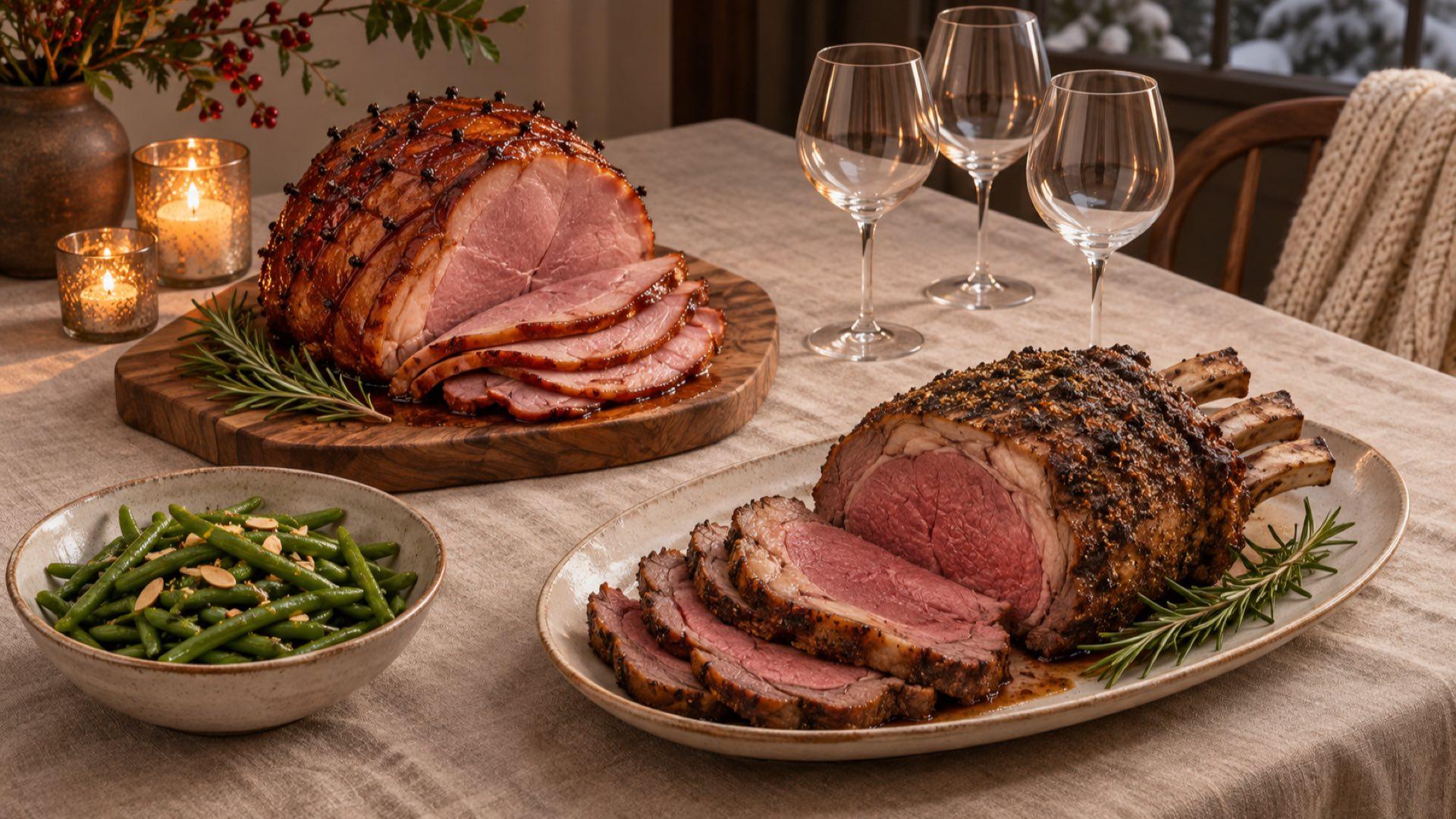
Ham is salty, and salt is hard on wine. It makes the tannin in a red feel rougher and the acidity in a crisp white feel sharper. With very salty food, some high-acid whites can even taste metallic.[2]
The fix is a touch of sugar in the glass. A Virginia university guide uses semi-dry or off-dry Riesling with ham as its example: the sweetness in the wine offsets the salt. It also lists a slightly sweet rosé of Grenache with salty ham.[2]
A glazed ham adds sweetness of its own. When the food is sweet, the wine needs to be at least as sweet, or it tastes bitter and stripped of fruit. One more reason to skip a bone-dry wine here.[1],[2]
If you want a red, keep it light and low in tannin. The Court of Master Sommeliers lists Pinot Noir with charcuterie, and off-dry Riesling with glazed pork.[1]
Prime rib and roast beef: now the big reds
This is the one Christmas dish where a firm, tannic red makes sense. Fat and protein in the meat soften the drying feel of tannin, so the wine tastes smoother next to the beef than it does on its own.[1],[2]
The Virginia guide's own example is a young Cabernet Sauvignon with prime rib. The Court of Master Sommeliers says a well-marbled cut of red meat is what tames Cabernet Sauvignon's tannin.[2],[1]
In general, cold-weather roasts call for fuller reds with firmer tannin, and light reds tend to fade next to them.[1]
Not every red has to be big. The Virginia guide also pairs prime rib with an aged Pinot Noir, earthy wine next to meaty food.[2]
Turkey: the Thanksgiving answer still works
A Christmas turkey comes with the same crowd of sides as a Thanksgiving one: something sweet, something tart, something rich. The Court of Master Sommeliers says that mix calls for wines that are fruity, higher in acidity and lower in tannin.[1]
Fish and shellfish: keep it crisp
Tannin and fish oil do not get along. Together they can leave a metallic taste, so avoid big reds with oily fish like salmon.[1],[2]
Crisp whites with high acidity, such as Pinot Grigio and Sauvignon Blanc, suit grilled fish and shellfish. Salt in the food softens their acidity, which is why high-acid wines work with briny shellfish.[1]
If you want red with fish, choose a young, fruity red without much tannin. The Court of Master Sommeliers points to Pinot Noir with salmon.[2],[1]
One bottle for the whole table
Sparkling wine is the one the Court of Master Sommeliers points to when a single bottle has to work across many dishes. Bubbles and acidity together cut through fat, salt and richness.[1]
Dessert follows its own rule. At the end of the meal, pudding, pie and cookies are all sweet, so a dry wine will taste thin and sour next to them. If you pour anything with dessert, it should be at least as sweet as the dessert.[1],[2]
How cold to serve it
Temperature changes the match. Cold mutes sweetness and makes acidity and red-wine tannin feel stronger. The Virginia guide gives these serving ranges.[2]
- Sparkling and sweet wines: 40 to 45°F (4 to 7°C)[2]
- Dry whites and rosé: 50 to 60°F (10 to 16°C)[2]
- Light, low-tannin reds: 50 to 65°F (10 to 18°C)[2]
- Reds with medium to full body: 65 to 68°F (18 to 20°C)[2]
With central heating, rooms are often warmer than wine likes. A red served above about 64°F (18°C) can lose its freshness, but it should regain its balance once it cools back down. Never warm wine fast near a heater, which can damage it.[3]
In the end, have what you enjoy
The Virginia guide ends with one rule: have what you enjoy. It says good pairing is more like an experimental art than a science.[2]
Sources
- Court of Master Sommeliers Americas, How to Pair Wine With Food Guide. Read .
- Virginia Tech, Department of Food Science and Technology (Enology and Grape Chemistry), Matching Table Wines with Foods. Read .
- Wine & Spirit Education Trust, Ideal serving temperatures and top tips for wine storage. Read .
Keep reading
- What wine goes with Thanksgiving dinner? Start with the sides
- How to taste wine without feeling silly
- Should red wine be chilled? A little, and not like your white
Or start from the beginning with the free level 1 course: 13 short, hands-on lessons.
How we write these
Grapeling articles are researched, written and fact-checked with AI help. Every claim is compared against the sources above before an article goes live. We write about grapes, regions, styles and technique, never about brands or where to buy.
For adults of legal drinking age: 21+ in the US, 18+ in the UK. Please drink responsibly, or not at all.